Synopsis. What do you get when you combine prosthetics and 3D printing? In this inspiring talk, 17-year old Easton LaChappelle shows us how he has been using new technologies to print and build cheaper, customizable prosthetics that could change millions of lives.
Skylar Tibbits: The emergence of “4D printing” – 3D printing has grown in sophistication since the late 1970s; TED Fellow Skylar Tibbits is shaping the next development, which he calls 4D printing, where the fourth dimension is time. This emerging technology will allow us to print objects that then reshape themselves or self-assemble over time. Think: a printed cube that folds before your eyes, or a printed pipe able to sense the need to expand or contract. Originally published to YouTube on Apr 4, 2013.
Synopsis. Home 3D printers are getting more affordable every year. But they still require lots of troubleshooting, practice, and patience. Here’s the state of modern 3D printing, based on our experience with four generations of MakerBots. Watch this video if you’re just getting started with 3D printing or just curious about exactly what the process entails. First published to YouTube on 27 March 2013.
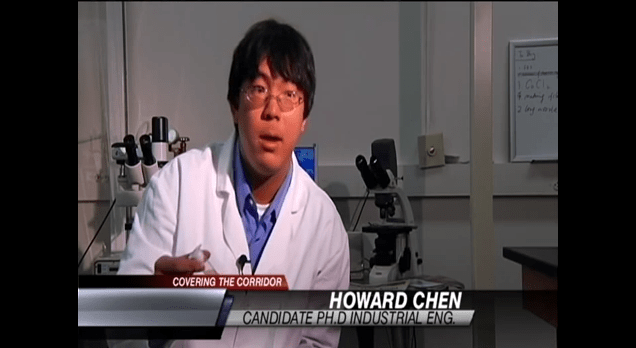
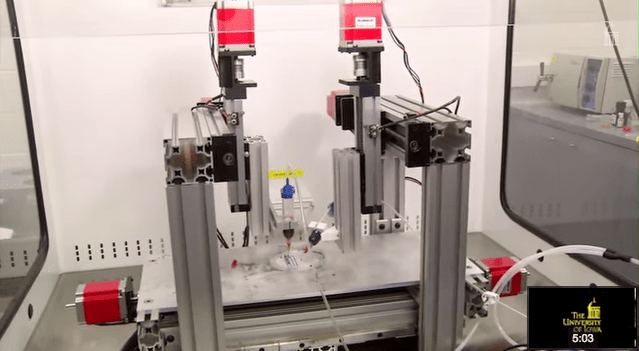
Synopsis. KGAN/KFXA’s Sadie Hughes shares how the University of Iowa’s College of Engineering is working to create human organs by using a 3D bioprinter. This video was first published to YouTube on 8 March 2013. (source)
Synopsis. The University of Iowa Mechanical and Industrial Engineering Department is working on organ printing, where they use a 3D printer to print living structures with bio-ink. The goal is to eventually print a working organ that can be transplanted into a human. This project is supported in part by the Institute for Clinical and Translational Science at the University of Iowa. This video was first published to YouTube on 20 February 2013.
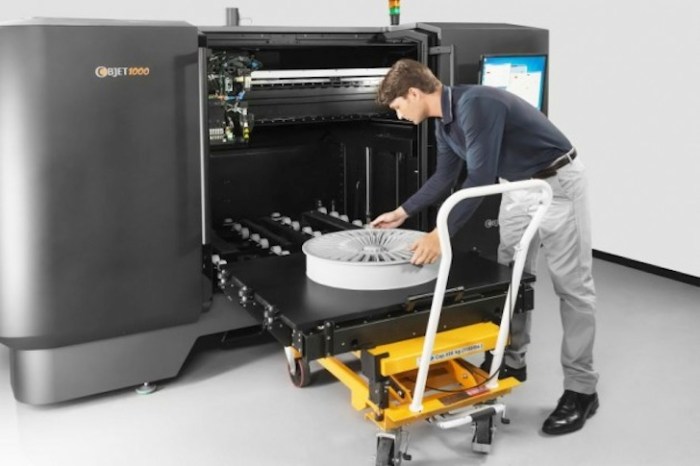
The Objet1000 is Objet’s largest ever 3D printer. With a build platform of 1000 x 800 x 500 mm (39 x 31 x 20 inch), the system enables designers, engineers and manufacturers to quickly and easily create large and very precise models for prototyping parts and products in automotive, defense, aerospace, consumer goods, household appliances and industrial machinery sectors. The system features Stratasys Objet Connex multi-material technology offering standard and ABS plastic performance, a choice of over 100 materials and the ability to mix up to 14 different materials in a single prototype or model to achieve the true look, feel and function of your intended end product.
This video was originally published to YouTube by Shapeways on Sep 5, 2012.
What is the future of creativity, manufacturing, and design? How is the Shapeways community and 3D printing enabling everyone to make their ideas real?
This film portrays how the Shapeways 3D printing community and marketplace is enabling everyone to be a creator. All you need is an idea and an Internet connection.
Directed by Stephan Malik
Produced by Carine Carmy, Shapeways
Featuring…
From Shapeways: Josh Levine, Peter Weijmarshausen, Carine Carmy, Brad Dickason, Gary Kenney, Duann Scott
From the Shapeways Community: Stijn van der Linden of Virtox, Jessica Rosenkrantz and Jesse Louis-Rosenberg of Nervous System, Michiel Cornelissen, Bernat Cuni of Cunicode, Carl Collins and Peter Knocke of GothamSmith
Featuring Designs by:
Bathsheba Grossman, Bits to Atoms, Columbia Aerodrome, Craig Kaplan, Cunicode, Gilbert13, GothamSmith, Joshua Harker, Meggo, Michiel Cornelissen, Museum of Small Things, Nervous System, Schreer Design, Shapeways, Spaho Design, Theo Jansen, Tristan Bethe, Vertigo Polka, Virtox, Wearable Planter.
Music by Tai Vare & Bill Wandel
Including: Principal Violin – Sonia Lee, Principal Cello – Tom Sullivan, Live strings recorded at Pearl Sound Studios by Chuck Alkazian
Special thanks to the Shapeways Community, the weather gods for enabling us to hit 5 cities in less than a week, and the future.
Originally published to YouTube by Kirsten Dirksen on 18 Aug 2012.
Synopsis
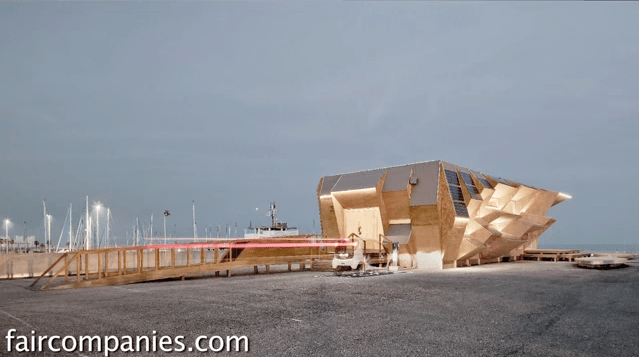
Solar House 2.0, erected this year on Barcelona’s waterfront, uses time-tested passive solar techniques, but it takes a high-tech leap forward using digital design and digital fabrication techniques to make it completely optimized for ideal solar gain.
With its jagged cantilevers jutting out at odd angles across most of the facade (except the North corner), Solar House 2.0 looks, and acts, like few other buildings. Thanks to digital design, the building’s structure was mathematically adjusted so that every point of the building was adapted to the exact conditions of the exterior.
Software also played a lead role in the building’s construction. Relying on 3D milling (for more on 3D printing see our video MakerBot: open source, self-replicating, stuff-making robot)- the Solar House designers employed a CNC (computer numerical control) wood router- the building’s individual pieces could be completely customized, creating the totally irregular patterns not possible (or affordable) with older, mass production techniques.
Solar House 2.0 was completely prefabricated so when the pieces arrived at the site, it took the team just 2 weeks to erect the 154-square-meter (1,658 sq ft) building. The building’s plans are open source and available to anyone who wants to build their own solar house, solar office or solar tower, but completely-customized to their location.




 Iowa City 3D Technologies